In the last Monthly Market Commentary of 2025, our European Strategist, Jeremy Batstone-Carr, looks back over a year of hard-earned returns as he reviews the various challenges investors have had to navigate.


In the last Monthly Market Commentary of 2025, our European Strategist, Jeremy Batstone-Carr, looks back over a year of hard-earned returns as he reviews the various challenges investors have had to navigate.
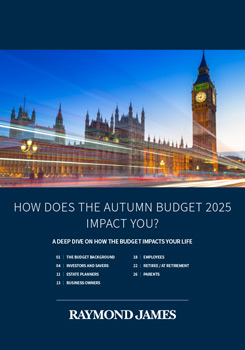
Our Autumn Budget Newsletter breaks down the Chancellor’s Autumn Statement, outlining its impact on individuals. Read an in-depth analysis on the following areas, plus more:

This edition of Monthly Market Commentary examines whether the rapid rise of Artificial Intelligence is fuelling a financial bubble. It explores the hype, the risks and the reality, with lessons drawn from the dot-com boom and the Global Financial Crisis to help investors assess today’s AI-led market dynamics.

August is typically a quiet month for the financial markets, however, this year it has been filled with market-moving news. Our European Strategist, Jeremy Batstone-Carr, examines key economic and geopolitical events of the last few weeks.
With US tariff negotiations still featuring heavily in the news, Raymond James European Strategist, Jeremy Batstone-Carr, considers recent developments and their potential effects on the global economy.
The article explores what Section 899 could have meant for global markets and why its absence may prove just as significant as its original inclusion.
This article originally appeared in Investment Strategy Quarterly – July 2025.
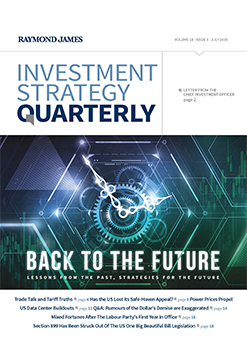
Our latest Investment Strategy Quarterly considers the complexities of today’s markets while drawing insights from the past. This edition includes the historic and current impact of tariffs, asks if the US still holds its safe-haven appeal for investors, and examines energy costs and AI. Closer to home, we take a look at Labour’s first year in office.

Flexible ISAs are not new products; they’re a new way in which some ISAs work. In a nutshell, with a flexible ISA you can take money out of your cash ISA and return it in the same tax year without reducing your annual allowance. Flexible ISAs will become “flexible” automatically – you don’t need to do anything in order to get the additional benefits of flexible withdrawals and payments. Both variable and fixed rate cash ISAs can become flexible ISAs – although not all flexible ISA providers offer flexibility on all their products.Continue reading

Inheritance ISAs are aimed at people whose partners had an ISA at the time of their death. The value of their combined ISA accounts at the time they died is added to your own ISA allowance. For example, if your partner had £20,000 in ISAs when they passed away, you would receive an additional ISA allowance of £20,000, giving you a total allowance of £40,000. Inheritance ISAs are available to anyone who has lost a husband, wife or civil partner since December 3, 2014. The additional allowance is available for three years after your partner has passed away, or 180 days after the administration of the estate has been completed (whichever is the later date). You can’t replace any money you take out; you can only use up your remaining allowance and you may only register your inherited ISA allowance with one provider.Continue reading

The growing popularity of alternative savings and investments schemes, such as peer-to-peer loans and crowdfunding services, has led to the government creating a new ISA category: the Innovative Finance ISA. Launched in April 2016, innovative finance ISAs are a half-way house between a cash ISA, which is safe but yields a low return, and a stocks and shares ISA, which offers more reward but carries far greater risk. Put simply, innovative finance ISAs enable you to lend out your own money – a bit like being your own bank manager.Continue reading

Another option for first-time buyers saving for a mortgage deposit is a help to buy ISA. With a help to buy ISA you can earn up to 2.27%interest tax free, and the government will add 25% tax free to whatever is in your ISA when you use it to buy a home. However, the bonus will only be available on homes costing under £250,000 (£450,000 in London). In addition, although you can use the help to buy ISA with any type of mortgage (not just a help to buy mortgage), it must be a residential mortgage and not buy-to-let.Continue reading

Launched in April 2017, the lifetime ISA is a government initiative to encourage people to save for their first home or their retirement. For every £4 you save, the government will add £1 (worth up to £1,000 a year) paid at the end of each tax year, up to the age of 50. Up to £4,000 a year is eligible for the government bonus, with the government adding a 25% bonus (up to £1,000 each year) on any contributions made before your 50th birthday.Continue reading
The value of investments, and the income derived from them, can fall as well as rise. You may get back less than invested. Past performance is not a reliable guide to future returns.